
Ultimate Guide Best Walking Boots for Ankle & Foot Injuries
Posted by Refisio Health on 14th Nov 2016
Ankle and foot injuries keep us immobile and feeling discomfort. Resting is one of the best ways to allow the ankle and foot injuries to heal quicker. However, being immobile and taking a few weeks off work may not be practical for some people.
Another option available is walking boot, it allows you to rest your injured foot or ankle while walking around. It can be used to treat injuries to the ankle and foot. Besides fractures, walking boot can be prescribed for other common ankle and foot injuries such as ball of foot pain, strains, sprains, heel pain and tendonitis, etc. They are also used post –surgery as an alternative to traditional plaster cast.
Walking boot is also known as walker, cast boot, Aircast boot, medical boot, moon boot, fracture boot, walking cast, cast walker and cam walker.
Types of Walking
Boot
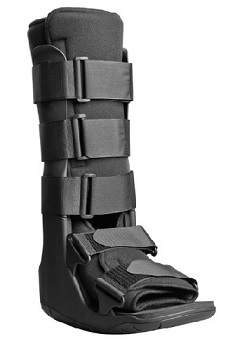
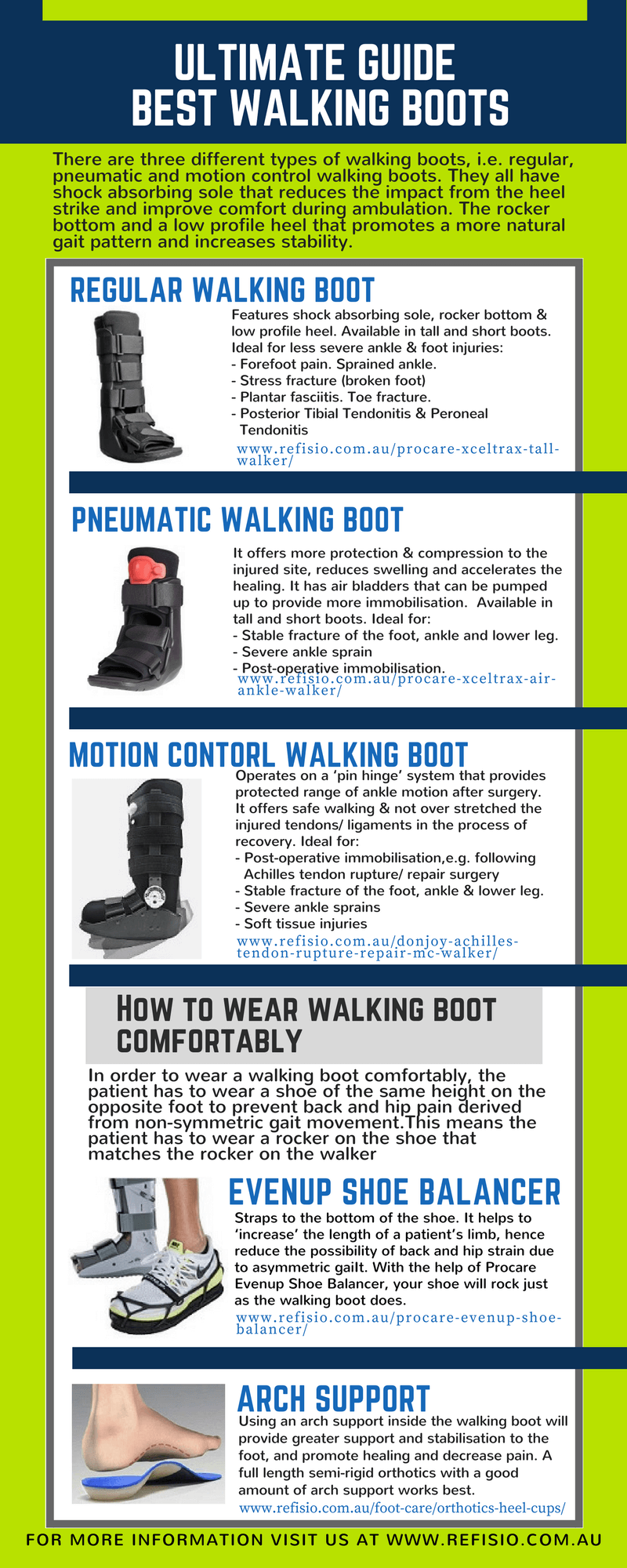
In general, there are three different types of walking boots, i.e. regular, pneumatic and motion control walker. They have tall and short designs.
Generally, the walkers have shock absorbing sole that reduce the impact from the heel strike and improve comfort during ambulation. The rocker bottom and a low profile heel that promotes a more natural gait pattern and increases stability.
Regular/ Standard Walking Boot, such as Procare XcelTrax Tall Walker and Procare XcelTrax Ankle Walker, both have features like shock absorbing sole, rocker bottom and low profile heel.
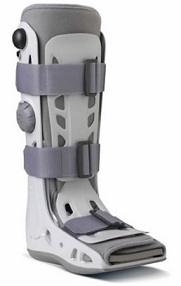
As Pneumatic Walking Boot, such as Aircast AirSelect Standard Walking Boot and Procare XcelTrax Air Tall Walker, both offer more protection as it has air bladders that can
be pumped up to provide more immobilisation, suitable for more severe injuries
and post-operative immobilisation.
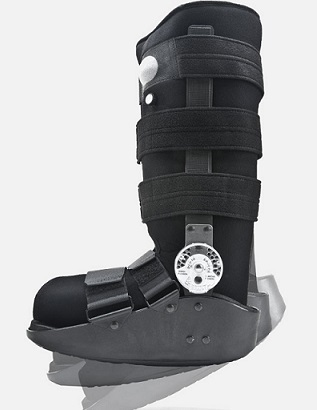
Motion Control Walking Boot such as Donjoy Motion Control Walker is designed to be used following repair surgery such as Achilles Tendon rupture. The walker uses a ‘pin hinge’ system to allow adjustable range of motion. This unique feature enables the surgeon to change the angle of the ankle joint, gradually put more stretch on the healing Achilles Tendon. The motion control walker allows patient to have a safe walking while still providing good protection after surgery.
Regular/ Standard Walking Boot
In general, a Regular/ Standard
walking boot is sufficient to provide adequate support to the following
less severe ankle and foot injuries.
Walking Boot for Forefoot Pain
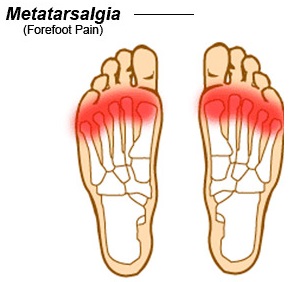
Some of the common forefoot/ ball of foot injuries are Metatarsalgia, Neuroma and Sesamoiditis, they are especially common in athletes who participates in high-impact sports that involve running and jumping.
Metatarsalgia is an overuse injury. Pain occurs at the end of the metatarsal bones, and it gets aggravated when walking or running.
Morton's neuroma is a swollen in the ball of the foot. This happens when the nerve that runs between toes are squeezed together for too often and for too long. The swelling make it painful when you walk on the foot.
Sesamoiditis, one of the common forefoot ailment and the pain usually come under the big toe joint.
The rocker base of regular walking boot reduces pressure under the forefoot as it helps to distribute the weight and pressure evenly across the foot. Both tall and short boots are suitable.
Walking Boot for Sprained Ankle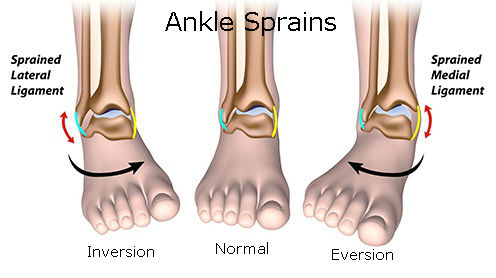
This happens when you have accidentally twisted your ankle, it gets swollen and painful as you may have over stretched and possibly torn the ligaments in your ankle.
To allow proper healing of the injured ligaments, health practitioner usually advises patients to immobilize the sprained ankle in a walking boot.
Always use the regular tall walking boot for ankle sprain as the short one may not provide adequate ankle protection.
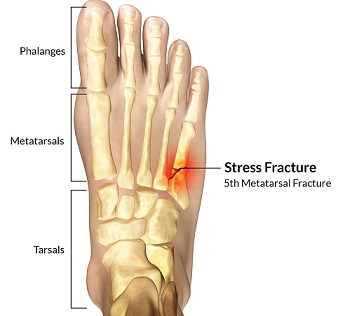
Walking Boot for Metatarsal Stress Fracture (Broken Foot)
Stress fracture is a small crack in a bone or severe bruising within
a bone. The most common site for a stress fracture is metatarsal. It is usually caused by overuse and repetitive
activities, common in athletes who participate in running sports.
Immobilized metatarsal stress fractures in a walking boot enables the stress
fracture heal faster and better.
As many of the muscles and ligaments connected to the metatarsal start in the leg, therefore it is advisable to get a regular tall walking boot to immobilise leg muscles which leads to the limit movement of the metatarsal.
Walking Boot for Plantar Fasciitis
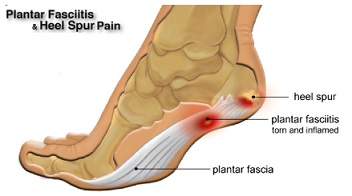
lantar Fasciitis is the inflammation of plantar fascia due to overstretch and overuse. The inflammation causes pain inside and along the sole and heel, the patient finds it discomfort to walk around.
The shock absorbing sole and rocker bottom of the walker protects and reduces tension of the inflamed plantar fascia, to allow the fascia rest and heal while the patient walking around.
Either a regular tall or short walking boot is sufficient to provide required support Most patients prefer a tall boot as it doesn’t irritate the shin. Short boot, maybe more suitable for short patient.
Sometimes a health practitioner may suggesting to add an arch support inside the boot, to provide greater support and take more tension away from plantar fascia.
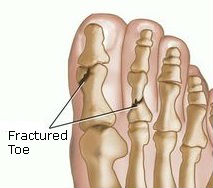
Walking Boot for Toe Fractures (Broken Toe)
For the same reason as metatarsal stress fracture,
it is better for the patient to wear a
regular tall walking boot for toe fractures as many of
the muscles that attach into the toe start in the upper leg. Immobilise those
muscles will limit the motion of the toe.
Walking Boot for Posterior Tibial Tendonitis and Peroneal
Tendonitis
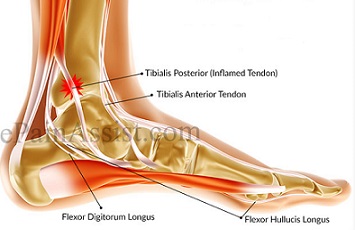
Posterior tibial tendonitis occurs when the posterior tibial tendon becomes inflamed or torn.
Peroneal tendonitis happened when one of the peroneal tendons is damaged, and this leads to subsequent degeneration and inflammation of the affected tendon.
When foot/ ankle tendonitis happened, the priority is to decrease tension on those tendons and allows healing to start. A tall walking boot is required as the inflamed tendons and its surrounding muscles are starting high up in the leg. Therefore, to best rest these muscles and tendon, the walking boot must go up high on the upper leg.
If the tendonitis in severe condition, it is advisable to wear an Aircast Pneumatic Tall Walking Boot.
Walking Boot for Foot/ Ankle Fractures
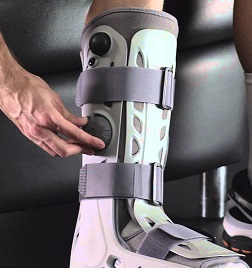
An Aircast Pneumatic Boot is ideal for treatment of stable fracture of the foot, ankle and lower leg, severe ankle sprain and post-operative Immobilisation. It offers more protection as it has air bladders that can be pumped up to provide compression for the swollen ankle/ foot. Besides the inflated air bladders immobilise the leg muscles. As a result, it reduces swelling and accelerate the healing process .
In addition, having a low rocker sole for ease of ambulation, the Aircast AirSelect Standard Walker come with a wider foot provides ample room for dressings. The semi-rigid shell to provide secure support and protection to the injured site .
Procare XcelTrax Air Tall walker is another pneumatic walker that has an integrated pump design making the pneumatic liner easy to inflate and modify pressure accordingly.
Tall boots are best for foot and ankle fractures as patient needs the extra protection to limit movement both the foot and the leg muscles that attach into the foot .
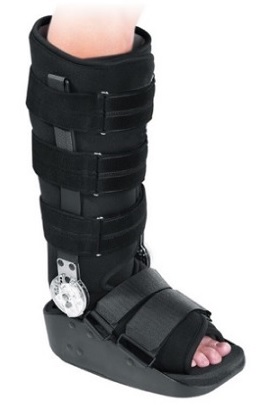
Donjoy Motion Control (MC) Walker is designed to promote early range of motion after surgery. It can be used following Achilles Tendon rupture/ repair surgery, stable fractures of the lower leg and ankle, acute ankle sprains and soft tissue injury.
Motion control walker operates on a ‘pin hinge’ system that offers protected range of ankle motion. It immobilised the foot and ankle at the neutral ankle position or 10 degrees, 20 degrees or 30 degrees each way, either toe up (dorsiflexion) or toe down (plantarflexion).
This unique feature enables the surgeon to change the angle of the ankle joint, gradually put more stretch on the ligaments/ tendons. By gradually stretching the tendon/ ligament, the outcome from surgery has been shown to be improved.
Overall, the Donjoy MC Walker allows patients to have a protected, safe walking and not over stretched the injured tendons/ ligaments in the process of recovery.
It is advisable to wear a sock when wearing the walker so there is no skin to material contact and avoid unnecessary abrasion to the ankle/ leg.Make sure you have tightened the straps at the bottom to a comfortable level to keep your foot from moving in overall there shouldn't be a lot of movement of you foot while in the walker.
How To Wear Walking Boot Comfortably
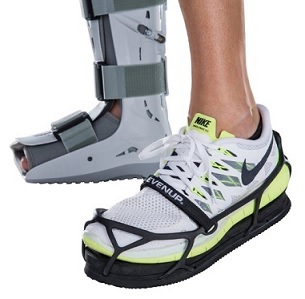
In order to wear a walking boot comfortably, the patient has to wear a shoe of the same height on the opposite foot to prevent back and hip pain derived from non symmetric gait movement.
This means the patient has to wear a rocker on the shoe that matches the rocker on the walker. This can be achieved with the use of Procare Evenup Shoe Balancer that straps to the bottom of the shoe. It helps to ‘increase’ the length of a patient’s limb, hence reduce the possibility of back and hip strain due to asymmetric gait.
With the help of Procare Evenup Shoe Balancer, your shoe will rock just as the walking boot does. This gives you a symmetric gait and will likely reduce body strain while walking with a walking boot.
Besides, using an arch support inside the walking boot will provide greater support and stabilisation to the foot, and promote healing and decrease pain. A full length semi-rigid orthotics with a good amount of arch support works best.
The information above is general in nature and is only intended to provide a summary of the subject matter covered. It is not a substitute for medical advice and you should always consult a trained professional practising in the area of sports medicine in relation to any injury. You use or rely on the information above at your own risk and no party involved in the production of this resource accepts any responsibility for the information contained within it or your use of that information.